This new Trimble facility in Westminster, Colo. will house 570 workers from various operations.

Today, Trimble broke ground on a new operations center in Westminster, Colo., with Gov. John Hickenlooper one of many to turn a shovel. The event was presided over by Steven Berglund, president and CEO of the company, who asserted that while the company is headquartered in Silicon Valley, Calif., most of their organic growth would take place in Colorado. The new facility adds a great deal of that expansion capacity with room for 570 people in a picturesque spot close to the mountains and to both Boulder and Denver. With this move, the company helps ensure the continued stature of Colorado as a geospatial hub, building on a long legacy of top-tier companies located here.

Trimble president and CEO, Steven Berglund, addresses the crowd at the building groundbreaking.

Trimble first moved some operations to Colorado in 1999, during the height of the Dot-com frenzy, when it was expensive and difficult to grow in California. That year, an advance team of 40 relocated to Westminster after an analysis of attractive cities within a two-hour flight from San Francisco International Airport concluded, with the Colorado Front Range as the winner. At that time, Trimble was mostly a GPS company, with revenues that year of $270M. The company has grown and diversified greatly since, with revenues of $2B last year and a market cap of roughly $6.3B. The recent announced acquisition of SketchUp from Google, with headquarters within a 30-minute drive in Boulder, makes their Colorado expansion even greater.

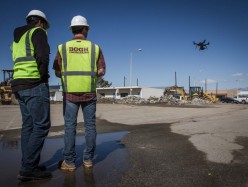
Work on the new headquarters facility will incorporate a great deal of Trimble technology throughout the building process, from surveying, to site work, excavation, 3D modeling, project management and construction layout. The site was prepared using Trimble technology for machine-controlled grading, which was done well ahead of schedule, due to the integration of a digital workflow from model right to the grading machines. In fact, the entire process is almost entirely digital, and Berglund took the opportunity to mention to the politicians present that the project might be further streamlined if they could keep the models in a digital format for permitting and building review, rather than having to revert back to paper.

A prism and rugged tablet were fixed to the Governor's shovel for precise positioning.

Governor John Hickenlooper was given a specially-equipped shovel with a prism on top and a rugged tablet with field software mated to a robotic Total Station for precise positioning. The Governor preceded the shovel work with a short speech that commended Trimble’s stellar growth in a tough economy, and for their far-forward vision that is speeding innovation and creating great value for their stockholders. The governor lauded the company’s ability to stay ahead of competitors with technology that provides efficiency gains.

The groundbreaking took place on a beautiful bluebird Colorado day.

The project makes use of Trimble’s entire BIM-to-Field workflow, with pieces for electrical and piping estimating, Tekla BIM software for structural models and collaboration, project managing and scheduling with Meridian Prolog Project Management, Field Link Robotic Layout for job site layout and measurement, CX 3D lasers to collect and update the 3D model, and a central Trimble Connected Community website to track and communicate the project’s progress. In fact, you can learn details of the project yourself on that interactive and detailed project management site:  http://newbuilding.trimble.com.

{ 1 comment }

GeoEye Proposes to Purchase DigitalGlobe

by Matt Ball on May 4, 2012

The mergers and acquisitions within the geospatial technology space are white hot right now, with news today that GeoEye has approached DigitalGlobe in order to acquire and combine companies. The result would be the world’s largest commercial high-resolution satellite company, with streamlined operations that would ensure viability in the face of deep federal cuts.

In addition to high-resolution satellite assets, the combined companies would also align on analytical services. The companies have increasingly focused on the added value of their information, with forays into marine, agriculture, natural resources, and other services in order to balance the military investment, which has proven to be unreliable of late.

Matt O’Connell, chief executive officer and president of GeoEye, said, “This proposal delivers exceptional value for the combatant commanders, national decision makers, civil users and disaster relief workers, who have a critical need for unclassified commercial imagery. It also provides benefits for the taxpayer. It offers our Government a way to get the information it needs while still reducing its funding obligations. The synergies in the combination will also benefit the shareholders of both companies.”

O’Connell continued, “In the face of significant pressure on the U.S. defense budget and intensifying international competition, a combined company will be better positioned to provide the U.S. government with the time-sensitive geospatial intelligence that is needed to support its mission in a very cost-effective manner during these fiscally conservative times. The government is looking to its providers for innovative solutions, and we believe this is the best option to achieve that.”

The move makes a great deal of sense in face of the ending of current conflicts that have spurred such high imagery demand, and with newer defense surveillance satellites that have added a great deal of military imaging capacity. For long-term growth of the commercial satellite industry, one strong global player with deep analytical services, could greatly improve the entire industry’s outlook. The energy spent in direct competition could then be applied toward extending the full potential of a fleet of sensors that provide the most accurate real-time picture of our world.

The proposed transaction would give DigitalGlobe shareholders $17.00 per share in total consideration, payable $8.50 per share in cash and $8.50 in GeoEye stock, or 0.3537 shares of GeoEye stock for each share of DigitalGlobe stock. This price represents a 26% premium to DigitalGlobe’s closing share price on May 3, 2012. The proposal is structured to provide DigitalGlobe shareholders with the opportunity to participate in the dynamic future growth of the combined company.

There’s no official word from DigitalGlobe yet on this $792 million offer, but it certainly looks attractive. There’s also the matter of SEC approval, which may hold some resistance due to the loss of competition in the marketplace.

This proactive move, with correspondence between company presidents over the past few months, focuses on the value to the U.S. Government and taxpayer, as well as to the commercial benefits, and the heightened capacities and competition from international commercial satellite vendors. With an acknowledgement to an “uncertain political and fiscal climate,” GeoEye’s CEO Matt O’Connnell, in a letter to DigitalGlobe CEO Jeffrey Tarr, states that, “we believe it is in our mutual interest to provide our customers with creative solutions to problems rather than passively speculate on one or another outcome.”

The past few months of speculation have certainly been trying for both companies, whose stock prices have fluctuated widely as federal budget figures have been made public. Both companies had press releases this week of their first quarter performance that also affirmed that they will each receive full government support for the 2012 budget year, which amount to $111 million for GeoEye, and $250 million for DigitalGlobe. What remains uncertain is the 2013 commitment that has been proposed in the President’s budget to fall from $540 million to $250 million.

The openness of these public companies provides a wealth of detail regarding their performance to date, the growth of particular market segments, the diversity of their customer base, their hardware and network capacity, their investments in research and development, and their various service offerings. There’s a great deal of insight to be gleaned from the investor relations pages on each company’s website through annual reports and quarterly earnings statements.

Some highlights from the companies include:

  • the creation of an Analysis Center at DigitalGlobe that focuses on rapid response to world crisis events, such as political unrest and natural disasters
  • the enhancement of DigitalGlobe’s ground station capacity that greatly speeds the time from collection to delivery, with just hours in between
  • the creation of GeoEye’s eyeQ software-as-a-service platform to provide seamless integration of imagery with other spatial information
  • GeoEye’s expanding Marine Services group that provides both fish-finding and oceanic data and services

There is also the matter of the planned launch of GeoEye-2 in the first half of 2013, and the launch of DigitalGlobe’s WorldView-3 satellite in mid-2014. Both satellites are being developed as part of a public/private partnership that is the Enhanced View program. WorldView-3 is slated to have 0.31 meter resolution, eight-band mulitspectral imagery, and eight-band short-wave infrared (SWIR) imagery. GeoEye-2 will have a 0.25 meter resolution, the highest resolution commercially available. With current federal restrictions on the commercial sale of imagery to 0.5 meter resolutions, the companies can’t fully capitalize on resolution, which makes the number of visits compelling from a global competitive standpoint.

DigitalGlobe has three satellites currently in orbit with QuickBird, WorldView-1, and WorldView-2 that combined visit the same point on the ground globally twice per day. GeoEye has IKONOS, which launched in 2009, and GeoEye-1 with the highest resolution available at .041 meter panchromatic and 1.65-meter multispectral. The combined force of five satellites, with two on the way, would prove to be a powerful combination able to visit the same point on the planet three times per day. The two companies also have complimentary sensors thanks to the move on behalf of both companies to diversify their satellite capabilities against one another.

Commercial satellite imagery is big business, with GeoEye projecting revenues for 2012 from $355 million to $375 million, and DigitalGlobe projecting 14% growth for 2012 that would amount to more than $385 million. A combined company with yearly revenues of more than $700 million, and with considerably reduced overhead, would certainly be an attractive investment. I’m eager to see what all the stock market analysts make of this merger.

{ 0 comments }

New Report Warns About Decline in U.S. Earth Observation Capabilities

May 2, 2012

The Natural Research Council has just released a detailed report that cautions about a decline in U.S. earth observation capacity. In a time of tightened budgets, many of the long-running missions are coming to a close, with follow-on missions delayed or canceled. The report follows a similar effort five years ago, with the title, “Earth [...]

Read the full article →

Google Looks to Add Iceland Fishing Data to Google Earth

April 30, 2012

The president of Iceland met with Google at a world oceans event in Singapore this year, and dialogue was started regarding the integration of fish monitoring data with Google Earth. The president sees information technology as a key to sustainability, and has been a proponent of the Iceland IT sector that have developed a number [...]

Read the full article →

The Connection Between SDI and Economic Development

April 29, 2012

A recent paper [PDF] by M. Shoko and Njike, presented at the first Conference on Advances in Geomatics Research, looks at the importance of spatial data infrastructure (SDI) for economic health and recovery for Zimbabwe. SDI provides access to spatial information for decision making, and is said to play a vital role for both government [...]

Read the full article →

Why did Trimble buy SketchUp, and why did Google sell?

April 26, 2012

It’s funny, my first reaction to the Trimble buys SketchUp news was that it was some kind of spoof, and I checked the link and site closely. It was surprising, because who knew that Google was selling anything, and while very strategic for both Trimble and Google, it’s hard to imagine how this went down. [...]

Read the full article →

Trimble Acquires SketchUp from Google

April 26, 2012

Trimble has announced today the agreement to acquire SketchUp from Google. This is very interesting news for the advancement of 3D modeling, with potential to tie more directly to data capture tools through the many handheld and scanning technologies that the company provides. Trimble will partner with Google on running and developing SketchUp’s 3D Warehouse. [...]

Read the full article →

Neogeographers for Environmental Monitoring

April 26, 2012

There was a presentation today at the Geospatial World Forum in Amsterdam by Eduardo Dias, with the SPIN spatial information laboratory also with Geodan, developers of tools to support crisis assessment, reconstruction and recovery. The company developed tools for Deforest Action, to incorporate satellite imagery, citizen sensors, collective intelligence and distributed computing to help keep track [...]

Read the full article →

Eye on Earth Noise Watch App

April 26, 2012

An Eye on Earth mobile-based application from the European Environment Agency (EEA) gives individuals an opportunity to sense the noise level around them, and aggregates all the citizens as sensors to derive broader noise maps of specific geographies. This addition of noise to existing Water Watch and Air Watch, gives citizens a suite of pollution [...]

Read the full article →

Maintaining the Responsibility of Land Ownership

April 25, 2012

Wubbo Ockels, former astronaut and professor of Aerospace for Sustainable Engineering and Technology at the Delft University, Netherlands spoke this morning at the Geospatial World Forum in Amsterdam. As a former astronaut for The Netherlands, he has a unique perspective regarding the responsibility that we have for our planet, having gone beyond the bounds of [...]

Read the full article →